Summary
Greece offers a preferential non-dom tax regime for investors, allowing them to legally reduce their tax burden to a fixed amount or a favourable rate.
Holders of non-dom status pay €100,000 a year instead of the standard income tax rate of up to 44%. Retirees are taxed at 7% on worldwide income, while entrepreneurs and employees receive a 50% discount on income tax for 7 years.
Here is how to benefit from the non-dom regime in Greece, and how it compares with similar regimes in other countries.
What is the non-dom regime and who can apply?
Non-dom is a preferential tax regime for wealthy foreigners who:
- change their tax residency to Greece;
- make an investment of at least €500,000 in the country’s economy.
The regime replaces standard taxation with either a fixed amount or a reduced rate, depending on the applicant’s category: investor, pensioner, or employee.
Greece’s non-dom framework is set out in the Income Tax Code, Law 4172/2013[1]. The core investor rules are in Article 5A, with complementary provisions for pensioners and for employment and self-employment in Articles 5B and 5 °C.
What are the tax benefits under the non-dom regime?
Residents pay national income tax on their annual taxable income using progressive bands[2]. The figures below show the headline rates:
- up to €10,000 — 9%;
- €10,001 to 20,000 — 22%;
- €20,001 to 30,000 — 28%;
- €30,001 to 40,000 — 36%;
- above €40,000 — 44%.
For example, an investor earns €300,000 abroad. Using Greece’s progressive bands, the tax on that amount is €123,900 in total: €9,500 on the first €40,000; plus 44% on the remaining €260,000, which is €114,400.
Under the non-dom regime for investors, they instead pay a fixed €100,000 on all non-Greek income, reducing the bill by €23,900 for that year.
Income tax in Greece and how non-dom reduces the bill
What are the benefits and regime features for retirees?
Pensioners pay a flat tax rate of 7% on all foreign income, including pensions, dividends, bank interest, rental income from foreign real estate, and capital gains.
Greece’s non-dom tax for retirees lasts for 15 years. The requirement is to have not been a Greek tax resident for 5 of the past 6 years.
Pensioners are not required to invest in the Greek economy, but the benefits do not extend to their family members.
What are the pros and terms for entrepreneurs and employees?
Entrepreneurs and employees receive a 50% discount on income tax on their Greek-sourced income for 7 years. The requirement is to have not been a Greek tax resident for 5 of the past 6 years.
The non-dom regime is particularly suitable for owners of international holdings, wealthy individuals with income in different jurisdictions, international professionals, and families with significant capital.
What is the tax amount and terms for investors?
Investors pay a fixed annual tax of €100,000 on any income earned abroad. For comparison, Italy has a similar regime with a tax of €200,000 per year.
The non-dom regime for investors in Greece is valid for 15 years and cannot be extended. The main requirements are to have not been a Greek tax resident for 7 of the past 8 years, and to invest at least €500,000 in the Greek economy, for example in real estate.
The Greece Golden Visa is an alternative to the €500,000 investment. Foreigners can obtain a residence permit in Greece by investing €250,000 or more. Holders of such a residence permit do not need to provide additional proof of investments when applying for non-dom status.

What are the 5 benefits of being a non-dom?
Non-dom status in Greece delivers a fixed €100,000 tax on foreign income, simplified reporting with no foreign income declaration, exemptions on overseas inheritances and gifts, and long-term certainty. Benefits can last up to 15 years.
1. Fixed tax instead of progressive rates. Investors pay €100,000 a year regardless of the size of their foreign income.
For example, if a foreigner earns €300,000 a year in a country with a 44% tax rate, they would normally pay €123,000 in taxes. In Greece, under the non-dom regime, they would pay only €100,000, saving €23,000 annually.
2. Benefits for family members. The regime can also apply to a spouse, parents, and adult children. For each family member included, the tax is €20,000 a year.
3. No need to declare foreign income. Investors are not required to submit detailed declarations of their income earned abroad. This simplifies reporting and reduces the administrative burden.
4. No inheritance or gift tax. Assets located outside Greece are exempt from inheritance and gift tax when transferred to heirs or gifted to family members.
5. Predictable tax burden. The regime lasts for 15 years for investors and pensioners, and 7 years for entrepreneurs and employees. The tax rates remain unchanged throughout this period, which allows for long-term financial planning.
How to become a tax resident of Greece?
To become a Greek tax resident, first obtain an AFM tax number after arrival, then meet the 183-day presence rule in a calendar year or show that your centre of vital interests is in Greece.
Register a tax number. After arriving in Greece, one must obtain a tax identification number, AFM. To do this, foreigners submit Form M1 at the local tax office or at the Independent Authority for Public Revenue.
The required documents include an identity card and the details of a guarantor who holds a Greek passport or residence permit.
Spent more than half a year in the country. Foreigners are considered tax residents of Greece if they spend more than 183 days a year in the country. The count begins from the date of crossing the border.

Albert Ioffe,
Legal and Compliance Officer, certified CAMS specialist
To become a tax resident, it is not enough simply to obtain a residence permit in Greece. One must physically spend more than 183 days a year in the country. When a foreigner relocates to Greece mid-year, the 183-day period is counted from the date of arrival rather than from January 1st.
This means that the non-dom regime can be obtained in the very first year of living in Greece if the move is planned at the right time.
Who can qualify for a non-dom regime in Greece?
Once an investor has become a Greek tax resident, they are entitled to apply for non-dom status. They are qualified for Greece’s non-dom regime by becoming Greek tax residents, proving they were not Greek tax residents, and making an investment.
Eligibility requirements
The investor must confirm:
- evidence of non-residence in Greece for 7 of the previous 8 years;
- an investment of at least €500,000 in the Greek economy, made no more than 3 years before submitting the application;
- tax residency in Greece at the time of application.
If the applicant has already obtained a residence permit by investment, there is no need to provide additional confirmation of investment.
Application deadline
The application for non-dom status must be submitted to the Greek tax authority by March 31th of the year in which the applicant intends to use the benefits. Applications for family members must be submitted at the same time or later, but also no later than March 31st.
All supporting documents must be provided either with the application or within 60 days of submission.
Tax payment
If the application is approved, the investor pays a fixed tax: €100,000 for the main applicant and €20,000 for each family member included. The full amount must be paid in one instalment by the last working day of July each year.
If the payment is late or incomplete, the non-dom regime is automatically cancelled for the current year, and the taxpayer is transferred to the general tax regime.
Income declaration
Under the non-dom regime, investors are not obliged to declare income earned abroad. Income from Greek sources is taxed at the standard Greek rates and must be declared.
The tax year in Greece coincides with the calendar year. A tax return must be filed by June 30th each year, even if there is no taxable income
Greece Golden Visa requirements in 2025
To qualify for the Greece Golden Visa, the main applicant must be a non-EU national aged 18 or over, have a clean criminal record and be able to confirm the legality of funds.
The residence card is issued for 5 years at first and there is no language test or relocation requirement. Eligible family members include:
- spouse or registered partner;
- children under 21;
- parents of both the investor and the spouse.
Real estate remains the most popular path to the Greece Golden Visa because it combines a clear threshold with asset ownership and rental yield potential.
Since April 2024, the program uses two principal thresholds for ready property and keeps a narrow €250,000 route for specific reconstruction or conversion cases[3].
Real estate routes at a glance
Other eligible investment routes exist if you prefer financial assets rather than property. The minimum thresholds start from €350,000 for fund units, €500,000 for a fixed term bank deposit or for shares in a Greek company, and €800,000 for a portfolio of listed corporate or government bonds.
Interest in the Greece Golden Visa has climbed sharply in recent years. Applications rose from just 1,993 in 2021 to a record 9,289 in 2024, fuelled by a relatively low investment threshold, flexible rules and growing appeal among international investors[4].
In the first four months of 2025 alone, applications reached 3,506, pointing to another strong year. If this pace holds, Greece could exceed 10,000 Golden Visa applications by the end of 2025. That would be a new annual record[5].
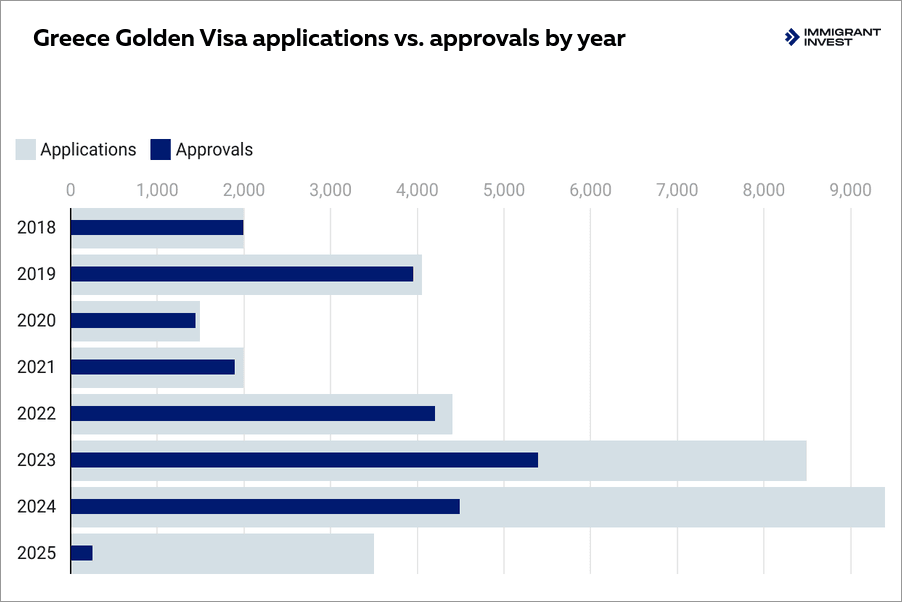
Between 2022 and 2024, the number of Greece Golden Visa applications surged, more than doubling to approach 9,000 in 2024
Step-by-step process: how does an investor obtain a residence permit and non-dom tax status in Greece?
According to Immigrant Invest’s legal experts, investors usually obtain non-dom tax status in Greece within about 10 months. During this time, the applicant receives a Greek residence permit and becomes a tax resident.
1 day
Preliminary check
Certified Compliance Officers at Immigrant Invest review the investor’s documents and assess their background to estimate the likelihood of obtaining a residence permit. This minimises the risk of refusal to as little as 1%.
If any risk factors are identified, Immigrant Invest proposes solutions, such as submitting an affidavit.
Certified Compliance Officers at Immigrant Invest review the investor’s documents and assess their background to estimate the likelihood of obtaining a residence permit. This minimises the risk of refusal to as little as 1%.
If any risk factors are identified, Immigrant Invest proposes solutions, such as submitting an affidavit.
1+ week
Choosing an investment option
Purchasing real estate is the most popular choice among investors. Immigrant Invest property experts help select a suitable property based on the investor’s goals and budget. Our real estate database includes around 200 projects eligible for residence permits by investment.
Purchasing real estate is the most popular choice among investors. Immigrant Invest property experts help select a suitable property based on the investor’s goals and budget. Our real estate database includes around 200 projects eligible for residence permits by investment.
1+ week
Preparing documents
Lawyers complete the government forms and prepare a tailored document checklist for the investor’s case. A standard package includes:
- completed application form;
- valid passport;
- proof of payment of state fees;
- health insurance;
- marriage certificate;
- children’s birth certificates.
Additional documents depend on the chosen investment option. For example, property buyers provide a sale and purchase agreement and a registration certificate from the Land Registry. All documents must be translated into Greek and apostilled.
Lawyers complete the government forms and prepare a tailored document checklist for the investor’s case. A standard package includes:
- completed application form;
- valid passport;
- proof of payment of state fees;
- health insurance;
- marriage certificate;
- children’s birth certificates.
Additional documents depend on the chosen investment option. For example, property buyers provide a sale and purchase agreement and a registration certificate from the Land Registry. All documents must be translated into Greek and apostilled.
Up to 1 week
Obtaining a tax number in Greece
The tax identification number, AFM, is required for major transactions, including real estate purchases. A lawyer submits the application and documents to the tax office. The number is usually issued within 3—7 days.
The tax identification number, AFM, is required for major transactions, including real estate purchases. A lawyer submits the application and documents to the tax office. The number is usually issued within 3—7 days.
1+ months
Fulfilling the investment requirement
For property purchases, the investor signs a preliminary agreement and pays a 10% deposit. Lawyers and a notary then prepare the final agreement.
Once the full amount is paid and the contract signed, the lawyer registers the property in the Land Registry and obtains a certificate of registration.
The investor receives the property documents together with a certified translation.
For property purchases, the investor signs a preliminary agreement and pays a 10% deposit. Lawyers and a notary then prepare the final agreement.
Once the full amount is paid and the contract signed, the lawyer registers the property in the Land Registry and obtains a certificate of registration.
The investor receives the property documents together with a certified translation.
1 day
Applying for a residence permit
The application is submitted online through the official website of the Greek migration service. Within a week, the investor receives a certificate allowing them to stay in Greece for 1 year while awaiting the residence permit decision.
The application is submitted online through the official website of the Greek migration service. Within a week, the investor receives a certificate allowing them to stay in Greece for 1 year while awaiting the residence permit decision.
1 day
Biometric data submission
All applicants provide biometric data, photos and fingerprints, for the residence permit card. Appointments are usually available within 1—2 weeks.
A lawyer arranges the date and time at the local migration office. A visa is required for entry to Greece.
Biometrics must be submitted within 6 months of application and before the 1-year certificate expires.
All applicants provide biometric data, photos and fingerprints, for the residence permit card. Appointments are usually available within 1—2 weeks.
A lawyer arranges the date and time at the local migration office. A visa is required for entry to Greece.
Biometrics must be submitted within 6 months of application and before the 1-year certificate expires.
3+ months
Receiving residence permit cards
The investor can collect the residence permit card personally or authorise a lawyer to do so. The passport and the application certificate must be presented when collecting the card.
The investor can collect the residence permit card personally or authorise a lawyer to do so. The passport and the application certificate must be presented when collecting the card.
6 months
Becoming a tax resident
Tax residency is granted on the basis of actual presence in the country and a valid residence permit.
To qualify, the investor must spend at least 183 days a year in Greece, starting from the date of entry.
Tax residency is granted on the basis of actual presence in the country and a valid residence permit.
To qualify, the investor must spend at least 183 days a year in Greece, starting from the date of entry.
1 day
Applying for the non-dom regime
The application is submitted to the Greek tax authority by March 31th of the year in which the investor wishes to use the benefits.
The required documents include the tax number, Greek residence permit, and confirmation of tax residency, like a certificate issued by the tax office. Supporting documents may be filed together with the application or within 60 days thereafter.
The application is submitted to the Greek tax authority by March 31th of the year in which the investor wishes to use the benefits.
The required documents include the tax number, Greek residence permit, and confirmation of tax residency, like a certificate issued by the tax office. Supporting documents may be filed together with the application or within 60 days thereafter.
How can a pensioner qualify for Greece’s non-dom regime?
Like investors, pensioners may apply for the non-dom regime only after obtaining Greek tax residency.
Confirm eligibility
A pensioner must confirm:
- that they have not been a Greek tax resident for 5 of the past 6 years prior to application;
- official pensioner status in a country that has a double taxation treaty with Greece;
- Greek tax residency at the time of application.
Submit application by deadline
The application must be submitted to the Greek tax authority by March 31th of the year in which the applicant wishes to begin using the regime.
Pay taxes
If approved, the pensioner pays a flat tax of 7% on all foreign income. The tax is calculated on total overseas income and must be paid in one instalment by the last working day of July each year.
Failure to pay on time or in full results in loss of eligibility for the preferential regime.
Declare income
Unlike investors, pensioners are required to declare all income, both Greek and foreign. Income earned in Greece is taxed at the standard rates.
Albert Ioffe,
Legal and Compliance Officer, certified CAMS specialist
The non-dom regime is particularly attractive for pensioners who receive substantial pensions abroad but wish to live in Greece. For example, with an annual pension of €50,000, the preferential tax in Greece would amount to just €3,500 instead of €22,000 under the standard rates.
Preferential tax regimes in other countries
Cyprus, Italy, Malta, Portugal, and the UK use a flat annual charge, others tax only remitted income, and several set special rates for pensions or employment. Thresholds, durations and eligibility rules vary widely and are revised from time to time.
 Cyprus
The island offers a tax regime for non-domiciled residents. Those who become tax residents but have lived in Cyprus for less than 17 years are exempt from taxes on dividends and interest.
Additionally, Cyprus provides tax benefits for highly paid professionals. If a resident works in Cyprus and earns more than €55,000 a year, they may reduce their taxable income by 50%.
The benefit lasts for up to 17 years and applies only to employment income earned in Cyprus. For those earning below the threshold, an alternative applies: 20% of employment income is exempt from taxation for 7 years.
 Italy
Italy
The non-dom regime requires an annual flat tax of €200,000 on all foreign income, regardless of the amount. It lasts for up to 15 years.
To qualify, one must not have been a tax resident of Italy for at least nine of the past 10 years.
Family members can also be included in the regime, at an additional €25,000 per year for each relative.
 Malta
Malta
Foreigners who obtain residence in Malta by investment may benefit from a remittance-based tax system. Income not transferred to Malta is tax-free. If transferred, it is taxed at 15%, but the total annual tax cannot be less than €15,000.
Pensioners pay a flat rate of 15% provided they rent or purchase property in Malta on a long-term basis. The minimum annual tax is €7,500 plus €500 for each dependent.
 Portugal
Until 2024, Portugal offered the Non-habitual Resident, NHR regime. It granted a 10-year holiday on most foreign income, with a 0% rate on overseas income and 10% on pensions.
The IFICI regime has since replaced NHR. It applies a flat 20% tax rate to Portuguese income earned by highly qualified professionals. The program lasts for 10 years and exempts most foreign income from taxation. Unlike NHR, however, it does not cover pensions.
To qualify, applicants must not have been Portuguese tax residents for the previous 5 years and must work in eligible sectors such as scientific research, higher education, IT, or startups.
 United Kingdom
The non-dom regime, which existed for more than 200 years, was abolished in April 2025. It allowed foreigners to avoid paying taxes on income from abroad if it was not remitted to the UK.
The new Foreign Income and Gains regime offers 100% tax exemption on overseas income for the first 4 years of UK tax residency. It is available only to those who have not been UK tax residents during the previous 10 years.
Comparison of preferential tax regimes in different countries
Country

Greece
Benefit
€100,000 a year or 7%
Duration
15 years
Country
Cyprus
Benefit
0% on dividends and interest, 50% income relief
Duration
17 years
Country
Italy
Benefit
€200,000 a year
Duration
15 years
Country
Malta
Benefit
15% on income remitted to Malta
Duration
Unlimited
Country
Portugal
Benefit
20% on Portuguese income
Duration
10 years
Country
United Kingdom
Benefit
0% on overseas income
Duration
4 years
Country | Benefit | Duration |
|---|---|---|
Greece | €100,000 a year or 7% | 15 years |
Cyprus | 0% on dividends and interest, 50% income relief | 17 years |
Italy | €200,000 a year | 15 years |
Malta | 15% on income remitted to Malta | Unlimited |
Portugal | 20% on Portuguese income | 10 years |
United Kingdom | 0% on overseas income | 4 years |
Risks and obligations: what to watch out for
With Greece’s non-dom status you still have filing duties, the flat amount applies only to foreign income, and missing deadlines or breaching conditions can switch you back to ordinary taxation. Read the points below to see the main obligations, how audits work and the consequences of non-compliance.
Deadlines are strict
To use the regime in a given year, you must file your application with the tax authority by March 31st. If approved, the flat tax is due in a single instalment by the last working day of July.
Missing the deadline or paying late cancels the regime for that year and you fall back to the general tax rules.
Annual filing still matters
Even though investors do not have to declare foreign income under non-dom, a Greek tax return must be filed each year. The tax year matches the calendar year and the filing deadline is June 30th, even if there is nothing to pay.
What counts as Greek-source income
The flat €100,000 covers foreign income only. Income from Greek sources remains taxed at standard bands and must be declared.
Typical Greek-source items include salary for work performed in Greece, profits from a business carried on in Greece and rental income from property located in Greece.
Non-residents are also taxed on Greek-source income such as rent from a Greek property.
Investment proof and timing
For Article 5A investors, eligibility includes investing at least €500,000 in the Greek economy within the 3 years before applying, or holding a residence permit by investment that already proves the investment.
Keep documents that confirm the amount, timing and nature of the investment in case the tax office requests them.
Audits and source-of-funds checks
While investors are not asked to document the origin of foreign income when applying, authorities may later request proof of the lawful origin of funds during a tax audit.
Be ready to supply bank statements, contracts and other evidence on request.
Family coverage has a cost
Adding family members increases the annual flat amount by €20,000 per person. Factor this into long-term planning, since the regime can run for up to 15 years for investors and pensioners.
Residency pitfalls
Simply holding a residence permit is not enough to become a tax resident. Tax residency turns on physical presence of more than 183 days in the year or on having your centre of vital interests in Greece.
Crossing the half-a-year threshold brings worldwide income into scope unless you are within a non-dom framework. Plan travel and ties accordingly.
Key points about the non-dom regime in Greece
- The Greek non-dom regime allows foreign investors to replace the standard tax rate with a fixed tax of €100,000 a year on any overseas income. The regime lasts for up to 15 years.
- Proof of investment in the Greek economy is a mandatory requirement for those wishing to use the non-dom regime. However, no additional proof is required if the applicant has already obtained a residence permit by investment.
- Foreign pensioners who become Greek tax residents may pay 7% on all overseas income, including pensions. This benefit also lasts for up to 15 years.
- Investors with non-dom status are not obliged to declare income earned abroad. Pensioners must declare all income, both Greek and foreign.
- The application for non-dom status must be submitted to the Greek tax authority by March 31th of the year when the applicant wishes to start using the regime. The preferential tax must be paid by the end of July.
Immigrant Invest is a licensed agent for citizenship and residence by investment programs in the EU, the Caribbean, Asia, and the Middle East. Take advantage of our global 15-year expertise — schedule a meeting with our investment programs experts.

Will you obtain residence by investment in Greece?
-
Master the residency process
-
Get expert tips and documents
-
Estimate costs accurately
 Trusted by 5000+ investors
Sources
- Source: Tax Incentives Law, Greek Tax Revenue
- Source: Personal income tax rate in Greece, PWC
- Source: Dual €800,000 and €400,000 thresholds, Law 5100/2024
- Source: Greece Golden Visa applications 2024, Greek Travel Pages
- Source: The Greek Ministry of Migration reported that Greece received 564 new Golden Visa applications in April 2025 alone