Summary
To obtain permanent residence in Cyprus, you need to invest at least €300,000 and be able to prove at least €50,000 of annual income outside Cyprus.
Applications for Cyprus permanent residence are considered within approximately 9 months; you can get the status together with your family.
Learn all the requirements of the Cyprus permanent residence by investment and who it is suitable for.
Why is Cyprus attractive to investors?
Cyprus is a popular destination for immigration or getting a "safe haven" among wealthy families, entrepreneurs and investors. The island is already a member of the European Union, but is not yet part of the Schengen Area; an application for membership is still pending.
The country has a high standard of living, high-quality healthcare, and good education, including several British schools.
Over the past decade, Cyprus' GDP has steadily increased by several percent per year, which makes the country’s economy one of the fastest growing in Europe.
Permanent residence by investment is interesting for investors for many reasons:
- Accelerated acquisition of Schengen visas.
- No taxes on foreign income, investments, inheritance, low rates of property, income and corporate taxes.
- Growing real estate market and stable rental income.
- Right to do business in Cyprus with the ease of starting a company.
- Free medical insurance.
- No need to know Turkish and Greek. For everyday communication, English is enough: 80% of the population speaks English.
- Fast processing of 9+ months instead of 5 years.
- Inclusion of family members.
- No physical presence requirements. It is enough, after the approval of the application, to fly to the country to submit the biometric data and visit the island once every 2 years.
- Indefinite validity of the status.
- Path to Cyprus citizenship 8 years after receiving permanent residence[1]. With a country passport, you can travel without visas to 170+ countries including the European Union and the United Kingdom.
The benefits make Cyprus one of the most attractive destinations in the European Union for relocation: the country is comfortable both for life and for doing business.
What are the investment options for obtaining permanent residence in Cyprus?
An investor can obtain permanent residence in Cyprus by investing €300,000+ in one of the following:
- residential real estate;
- commercial real estate;
- shares of Cypriot companies;
- shares of Cypriot investment funds.
Purchase of residential property
Buying housing is the most popular way to get permanent residence in Cyprus.
An investor may purchase one or two new-build properties with a combined value of at least €300,000 plus VAT. The standard VAT rate is 19%, but a reduced rate of 5% applies when the property is the buyer’s only home and intended for personal use. At the minimum investment level, this reduced VAT amounts to €15,000.
Only new properties qualify for permanent residency. Resales are not permitted. If two properties are purchased, they may be from different developers.
The purchase may be made in the investor’s name or through a company registered to the investor or their spouse, provided that either of them is the sole owner of that company.
The property must remain in the investor’s ownership throughout their residence status. It can be sold only after citizenship is granted. If the investor decides to sell earlier, they must purchase another one of equal or higher value.
Examples of villas in Cyprus


Cyprus, Limassol
€1,440,000 — €1,600,000
Villas in modern style, Agios Athanasios, Limassol
 555 m² — 579 m²
 5
5  5
5 
Cyprus, Paphos
€850,000 — €895,000
Elegant villas, Lower Chloraka, Paphos
282,000 m² — 284,000 m²4 4 
Cyprus, Paphos
€390,000 — €520,000
Cosy villas, Ha Potami, Paphos
125 m² — 171 m²2—3 2—3 Purchase of commercial real estate
Instead of a residential property, an investor can buy one or two commercial real estate for a total amount of €300,000 plus VAT of 19%, which is at least €57,000.
Commercial properties can be bought in both the primary and secondary markets. Offices, shops, hotels, or a combination of them qualify.
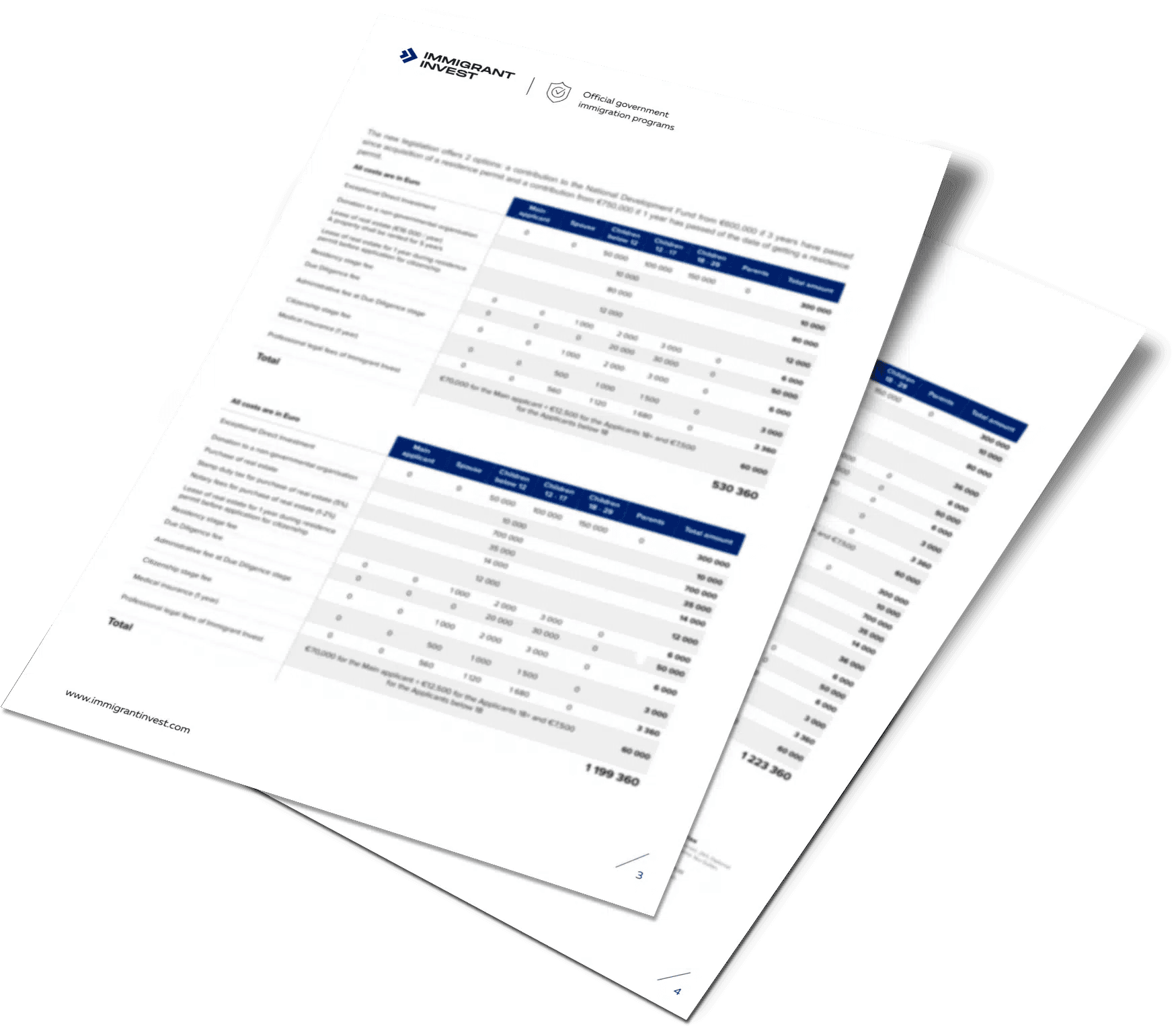
Full expenses on Cyprus PR under the property purchase option
Purchase of companies’ shares
Applicants can invest €300,000 in shares of Cypriot companies. The company must be registered and physically present in Cyprus and employ at least 5 people.
Permanent residence holders under the investment category cannot work as employees in these companies. However, they may serve as shareholders or directors, receiving dividends rather than salary.
Purchase of Cypriot investment fund’s shares
The investor can purchase units or shares of funds regulated by the Cyprus Securities and Exchange Commission for at least €300,000.
The permitted fund structures are:
- Alternative Investment Fund, AIF;
- AIF with Limited Number of Persons, AIFLNP;
- Registered Alternative Investment Fund, RAIF.
What are the requirements for applicants wishing to obtain permanent residence in Cyprus?
Just investing money is not enough to obtain status: the applicant is still required to prove the legality of the source of funds, earn enough money and have a permanent registration address in Cyprus.
For the main applicant
Requirements for investors when applying:
- no criminal record;
- no sanctions, restrictions, or bans on entry to EU countries and the UK;
- legitimate source of income;
- impeccable personal and business reputation;
- annual income of €50,000+ per year outside Cyprus; for each additional applicant, the income requirements increase by €15,000 for the spouse and by €10,000 for the children.
Investors must have a registered address in Cyprus. If the applicant contributes money to commercial real estate or local securities, they must still buy or rent residential property. There are no cost requirements.
It is not necessary to reside permanently in Cyprus, although, in order to maintain permanent residence, investors must fly to the island at least once every two years. Otherwise, the status may be canceled. However, obtaining a residence permit in another country is prohibited by the terms of the program.
Permanent residence in Cyprus is reserved for the investor’s family for life. To maintain it every year residents are required to prove the same source of income, keep investments and update their medical insurance. Every year each family member over 18 must renew their criminal record.
For family members
Together with the investor, permanent residence in Cyprus can be obtained by:
- spouse;
- children under 18;
- unmarried student children under 25 who are financially dependent on the main applicant;
- children of any age with physical or mental disabilities.
An adult and financially independent child can be included in the application, but an additional €300,000 will have to be added to the amount of investments, and the child must have an annual income of €30,000 or more.

How to secure your real estate investment?
Buying real estate in Cyprus requires careful legal verification. The island uses a mixed system where title deeds may not always be issued at the moment of purchase, especially for new developments. Proper due diligence protects the investor from construction risks, hidden liabilities and future disputes.
Understand the role of the title deed
A title deed is the official document proving property ownership in Cyprus. It confirms:
- legal owner of the property;
- boundaries and size of the land or unit;
- absence or presence of encumbrances, mortgages or court claims;
- whether the building has been legally completed and inspected.
When a property is new and still under construction, individual title deeds are issued only after the project is fully completed and certified by the authorities. Until then, buyers rely on a registered sales contract at the Land Registry, which provides strong but not identical protection.
Utilise legal protection tools
Cyprus law provides several safeguards for property buyers.
Escrow accounts. Payments can be held in an escrow account by a lawyer or licensed fiduciary and released only when agreed milestones are met. This prevents premature payments and protects buyers if the developer fails to deliver.
Bank waiver letters. If the land or project is mortgaged, the buyer must obtain a bank waiver. It ensures the bank releases the purchased unit from the developer’s debts, so the title deed is transferred free of encumbrances.
Sales contract registration. Registering the sales contract with the Cyprus Land Registry secures the buyer’s rights before the title deed is issued. Once registered, the property is reserved in the buyer’s name, cannot be resold or used as collateral by the developer, and gives the buyer enforceable legal protection, especially in off-plan purchases.
Verify the developer
Before signing any agreement, investors should ensure that the developer is fully compliant and financially stable. A standard verification includes:
- checking the developer’s licences and permits;
- confirming that planning and building permits match the property being sold;
- reviewing the developer’s track record and past projects;
- ensuring there are no outstanding mortgages, court cases or liens on the land;
- assessing whether the developer has a history of delayed titles.
The lawyer must independently obtain this information from the Land Registry, Planning Authority and relevant financial institutions
Check the property thoroughly
After the successful check of the developer, it is essential to verify a clean status of a chosen property. The process includes the following steps:
- Land Registry title search. Confirm the existence of a separate title deed, registered owner, boundaries and any mortgages, liens or charges.
- Planning and building permit check. Verify the planning permit, building permit and final approval certificate. This is crucial if the title deed has not yet been issued.
- Technical inspection. This step is optional but common. Hire a surveyor to check structural condition, damp, plumbing, materials and energy performance.
- Debt and obligation review. Ensure the seller or developer has no outstanding loans, taxes, utility bills or municipal fees tied to the property.
After the property passes due diligence, the lawyer drafts and checks the sales contract, setting out the payment timetable, delivery date, penalties, warranties and agreed conditions. Then, the contract is signed and filed with the Land Registry, which safeguards the buyer’s rights.
Following the final verifications, the Land Registry completes the transfer and issues the deed to the new owner.
What are the typical pitfalls when purchasing real estate and how to avoid them?
Buying property in Cyprus is generally straightforward, but the same problems appear again and again in poorly prepared transactions.
All the risks can be picked up in advance through a full legal search at the Land Registry and a check of planning and building documentation by an experienced lawyer. The Immigrant Invest team includes lawyers well-versed in Cypriot legislation and the real estate market.
Unverified planning and building permits
If a property has missing or irregular planning and building permits, the construction may be partially illegal or non-compliant. This can delay the issuance of the final certificate of approval and, as a result, the title deed. In some cases, rectifying the irregularities requires costly corrections or additional approvals.
To avoid this mistake, have an experienced lawyer verify all permits directly with the Town Planning and Building Authorities. Ensure the project has a valid planning permit, building permit and, where applicable, a certificate of approval or completion.
Existing mortgages or developer loans on the land
If the land or project is mortgaged, the bank’s claim may rank above the buyer’s rights. If the developer defaults, the bank can enforce the mortgage, which may jeopardise the transfer of the title deed.
To avoid this mistake, your lawyer should obtain a Land Registry search to confirm encumbrances and request a bank waiver letter. The waiver ensures the bank releases your specific unit from the mortgage once the contract terms are fulfilled.
Failure to register the sales contract
If the sales contract is not deposited with the Land Registry within the legal deadline, the buyer has no enforceable rights over the property. The developer can resell the property or use it as collateral without the buyer’s consent.
To avoid this mistake, ensure the signed sales contract is deposited promptly with the Land Registry. Contract registration protects the buyer until the title deed is issued, preventing resale or encumbrances by the seller.
Paying large amounts before due diligence is complete
Paying deposits or full price before completing legal checks exposes the buyer to financial loss if the project is delayed, non-compliant or disputed.
To avoid this mistake, use escrow arrangements for staged payments linked to construction or document milestones. Transfer funds only after legal due diligence is completed and a solid contract is executed and deposited.
Delays or complications in issuing title deeds
Some projects, especially new developments, may face delays in receiving final certificates required for issuing individual title deeds. This limits the buyer’s control and may restrict future sale or refinancing.
To avoid this mistake, choose reputable developers with a history of timely title deed issuance. Ask your lawyer to check the project’s compliance history and timelines. Register your contract to secure your rights until the deed is issued.
Hidden defects or construction quality issues
New builds may have snagging issues, and resale properties may contain structural or technical defects that are not visible during a basic viewing. Fixing these problems can be expensive and time-consuming.
To avoid this mistake, commission an independent technical survey before purchase. Include clear contractual clauses on completion standards, remedies and warranties. Inspect the property before final payment.
Buying from inexperienced, offshore, or unlicensed sellers
Unreliable sellers may provide incomplete documentation, make unrealistic promises or fail to deliver on contractual terms. This increases legal and financial risks.
To avoid this mistake, work only with licensed developers, registered land agents and independent local lawyers. Check the seller’s track record, financial standing and past projects.
What documents are required for applying for permanent residence in Cyprus?
Immigrant Invest lawyers will help in the collection and preparation of all papers including translation and apostille, filling out and submitting applications, as well as drafting affidavits for remote submission of documents.
But first you need to collect all the necessary documents:
- Completed application in the MIP1 form.
- Originals and copies of valid passports of the applicant and his family.
- Biography of the main applicant.
- Declaration of income confirming the amount of annual income of at least €50,000.
- Proof of investment. When investing in real estate, this is a certificate of ownership or a sale and purchase agreement. When investing in local securities, a share purchase agreement, a certificate of the owner of the shares and a certificate of incorporation.
- Proof of permanent address in Cyprus: certificate of ownership, or sales or lease agreement.
- Declaration of absence of employment in the territory of Cyprus.
- Applicants’ certificates of no criminal record.
- Marriage certificate.
- Birth certificate.
- Medical insurance for the whole family.
Children over 18 years of age need documents stating that they are studying at a university and financially dependent on the main applicant.
How to get permanent residence in Cyprus by investment?
The process of obtaining permanent residence by investment can be conducted almost entirely remotely. The applicants travel to Cyprus only to submit biometrics.
In Immigrant Invest experience, obtaining permanent residency takes 9+ months.
1 day
Preliminary Due Diligence
Immigrant Invest conducts a Preliminary Due Diligence check to identify any circumstances preventing the applicant from participation in the selected programme.
Upon successful completion of the check, Immigrant Invest prepares a service agreement to provide further support.
The process is fully confidential.
Immigrant Invest conducts a Preliminary Due Diligence check to identify any circumstances preventing the applicant from participation in the selected programme.
Upon successful completion of the check, Immigrant Invest prepares a service agreement to provide further support.
The process is fully confidential.
2+ weeks
Preparation of documents
After passing Due Diligence, we start collecting documents for the application. When all the documents are ready, we translate and apostille them and hand them over to our agent in Cyprus.
After passing Due Diligence, we start collecting documents for the application. When all the documents are ready, we translate and apostille them and hand them over to our agent in Cyprus.
1+ months
Fulfillment of the investment condition
The investor chooses one of the investment options. If they buy a property, they pay the developer at least €200,000. Property documents or sales contracts must be submitted to the Cyprus Land Department.
Immigrant Invest helps you choose an object, prepare a sales contract, and conduct a transaction.
The investor chooses one of the investment options. If they buy a property, they pay the developer at least €200,000. Property documents or sales contracts must be submitted to the Cyprus Land Department.
Immigrant Invest helps you choose an object, prepare a sales contract, and conduct a transaction.
3—6 months
Application and processing of the application
Immigrant Invest lawyers submit an application to the Civil Registry and Migration Department.
When applying, a fee of €500 will be charged for spouses and children under 18 years of age. For children under 25, an additional €500 per person must be paid. There is also a registration fee of €70 per person.
The Migration Department reviews the application and forwards it to the Secretary of the Ministry of the Interior, who will make a decision within two months.
Immigrant Invest lawyers submit an application to the Civil Registry and Migration Department.
When applying, a fee of €500 will be charged for spouses and children under 18 years of age. For children under 25, an additional €500 per person must be paid. There is also a registration fee of €70 per person.
The Migration Department reviews the application and forwards it to the Secretary of the Ministry of the Interior, who will make a decision within two months.
Up to 1.5 months
Issuance of permanent residence cards
After the approval of the application, the investor and his family will have to visit Cyprus within a year to submit biometric data and obtain a permanent residence permit in Cyprus.
After the approval of the application, the investor and his family will have to visit Cyprus within a year to submit biometric data and obtain a permanent residence permit in Cyprus.
What taxes do owners of permanent residence in Cyprus pay?
Cyprus has one of the most favourable tax regimes, making it an excellent place to do business in the European Union.
If the investor does not have a Cyprus tax residency, he does not have an obligation to pay tax on foreign income, including income from securities. Non-residents pay taxes only on income earned in Cyprus.
There are two ways to obtain tax residency status. The first one is standard: to spend more than 183 days a year in the country. The second is the so-called 60-day rule[2]. An investor can become a resident of the island if they meet one of the following conditions:
- hold permanent residence on the island;
- owns residential property in Cyprus;
- spent 60 days on the island during the applicable tax year;
- is not a tax resident of any other state, that is, he has not lived in another country for more than 183 days a year;
- runs a business in Cyprus.
Taxes for individuals
Tax residents of Cyprus pay income tax on all income, including global income, as well as other types of taxes. There is no tax on securities profits and capital gains.
Cyprus residents must pay income tax on a progressive scale:
- up to €19,500 per year — 0%;
- up to €28 000 per year — 20%;
- up to €36 300 per year — 25%;
- up to €60,000 per year — 30%;
- from €60,000 per year — 35%[3].
The annual property tax was abolished in 2017[4].
When selling Cypriot real estate, you must pay capital gains tax on the difference between the cost of selling and buying at a rate of 20%[5].
Residents are also subject to a special defense tax. It is levied on interest, dividend and rental income at rates up to 15%. If the resident has received dividends from Cypriot companies, no tax is required[6].
There is a special regime for retirees — 5% of the amount of pension payments if they exceed €3,420 per month[7].
Taxes for companies
Cyprus has one of the lowest corporate tax rates in the European Union: resident companies are taxed on their worldwide income at a rate of 12.5%[8] The company does not pay tax if it receives income from dividends, exchange rate differences, securities transactions, or a foreign branch of a Cypriot company.
There are also tax incentives for IT companies and those who make money by selling intellectual property. Non-resident companies pay tax only on income earned on the island. When restructuring a business, almost all of the income is deducted from tax.
Cyprus property market: overview
The real estate market in Cyprus continues to show sustained growth, underpinned by solid demand, rising prices, and strong investor interest. Residential property prices in 2025 have risen by approximately 2% year-on-year in Q1 and 1% in Q2[9].
Transaction volumes also reflect this trend. Official records indicate a strong rise in activity, with registered sale contracts increasing from 1,318 in October 2024 to 1,638 in October 2025, marking a 24% year-on-year increase[10].
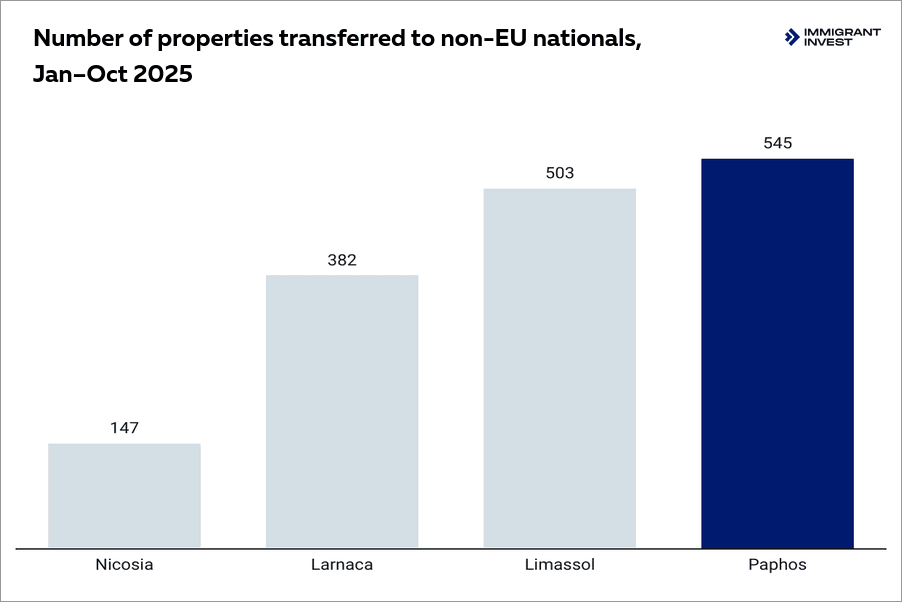
Regional dynamic
Price growth and market behaviour differ significantly across Cyprus’s major districts:
- Paphos offers lifestyle and holiday-home appeal, with relatively strong recent growth and good rental potential.
- Limassol remains the premium market: it leads in price levels and appeals strongly to high-net-worth investors.
- Larnaca is emerging as a value play: moderately priced compared to coastal luxury hubs, but increasingly popular for both purchase and rental markets.
- Nicosia shows steadier, slower growth and houses more domestic demand than foreign-investment driven demand; entry prices here are typically lower than coastal districts.
Supply and demand outlook
While demand remains strong, building-permit data suggest that new supply growth is moderating. This limited pipeline of new stock, especially in prime coastal districts, supports future price appreciation. At the same time, rental demand remains firm across the major urban centres thanks to local jobs, tourism and international residents.
Tax for real estate purchase
When purchasing real estate in Cyprus, the taxes and fees depend on whether the property is a new build or a resale.
For new properties, the standard VAT rate is 19%, reduced VAT rates are 9% and 5% apply.
For resale properties, where VAT does not apply, buyers pay transfer fees to the Department of Lands and Surveys. These are calculated on the property’s market value using a progressive scale:
- up to €85,500 — 3%;
- €85,500 to 170,000 — 5%;
- over €170,000 — 8%.
Transfer fees are not charged when VAT is applicable, and in cases where VAT is not imposed, the transfer fees may be reduced by half[11].
Legal and professional fees, including lawyer costs, are not set by law and vary depending on the service provider.
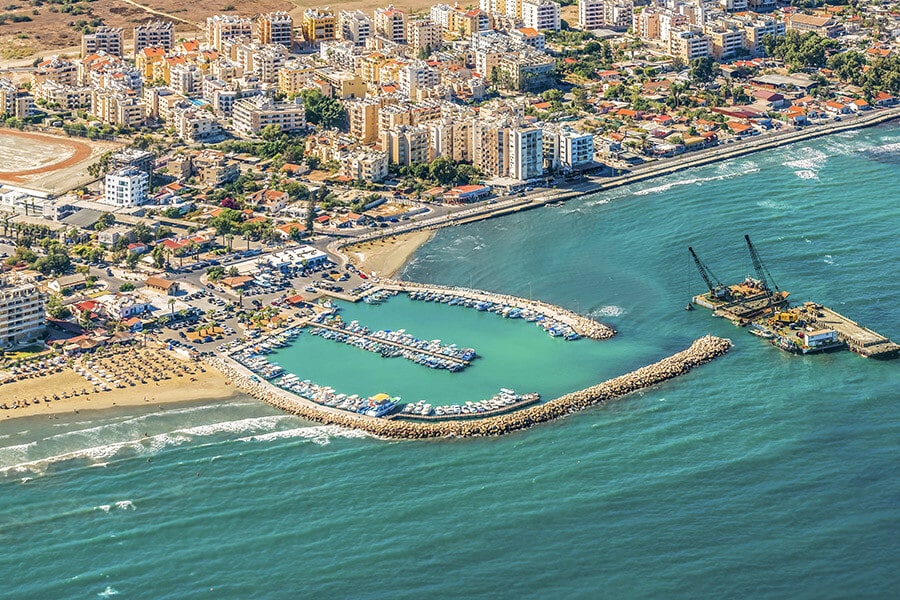
Prime seafront apartments in Limassol can reach €8,000 per m², reflecting strong luxury demand
What are the non-investment ways to get permanent residence in Cyprus?
Investing is the way to fast track permanent residency and the easiest way in Cyprus, but not the only one. The status can also be obtained by those who have passive income from outside Cyprus or live in the country for at least 5 years.
Category F route for financially independent people
Category F is a traditional permanent residence route in Cyprus for non-EU nationals who can prove a secure annual income from abroad and who do not intend to work in the country.
The income must originate from outside Cyprus — for instance, from pensions, dividends, or rental income. The minimum threshold is €9,568 for the main applicant, plus at least €4,613 for each dependent.
Applicants must also have adequate housing in Cyprus. The rules allow for either the purchase or long-term rental of a property.
Comparison of permanent residency by investment and Category F route
Long-term legal residence
Permanent residence by naturalisation can be obtained by those who have held a residence permit in Cyprus for more than 5 years.
Family reunification permanent residence is suitable for those whose husband or wife is a Cypriot citizen. In this case, a temporary residence permit is first issued, and after 5 years of living in the country, you can change the status to a permanent one.
How to obtain Cypriot citizenship?
From 2013 to 2020, Cyprus offered a citizenship program by investments from €2,200,000 for 5 years. But since November 2020, the investment citizenship program has been closed.
The owner of permanent residence in Cyprus can apply for citizenship by naturalisation: 8 years after obtaining the status, of which he must constantly be on the island for the last 12 months. Before applying, foreigners must pass language and culture tests and an interview.
Cyprus allows multiple citizenship, so the applicant will not have to give up his original citizenship.
The Cypriot passport allows the holder to travel without visas to 170+ countries, including the Schengen Area, the UK and Canada, as well as freely live, work and study in any country of the European Union.
Foreigners can also obtain Cypriot citizenship through marriage with a citizen of the island: 3 years after marriage and at least 2 years of life on the island, family reunification and birth in the family of citizens of the country.
Cyprus PR vs. citizenship: comparison
Who will benefit from permanent residence in Cyprus by investment?
Permanent residence in Cyprus is obtained mainly for the sake of tax benefits when investing and doing business. This is not the case when the status will help you travel without visas. To enter the Schengen countries, you need to apply for a visa, but according to an accelerated procedure.
Cyprus is also a great destination for those seeking a calm and comfortable life in the Mediterranean. The country is actively developing, the island has a mild climate with sun all year round.
Key takeaways about Cypriot PR by investment
- Non-EU nationals can obtain permanent residence in Cyprus by investing at least €300,000 in the country’s economy.
- Purchase of properties is the most common option for investors, as the Cypriot real estate market remains strong and growing.
- To be eligible for Cypriot PR by investment, the investor must have no criminal record, no sanctions, restrictions, or bans on entry to EU countries and the UK, legitimate sources of income, impeccable personal and business reputation, and annual income of €50,000+ per year outside Cyprus.
- The process of obtaining Cyprus permanent residency by investment takes 9+ months. Investors must visit the country once to submit biometrics.
- Investment permanent residency opens a path to Cyprus citizenship after 8 years.
Immigrant Invest is a licensed agent for citizenship and residence by investment programs in the EU, the Caribbean, Asia, and the Middle East. Take advantage of our global 15-year expertise — schedule a meeting with our investment programs experts.

Will you obtain permanent residence in Cyprus?
-
Master the residency process
-
Get expert tips and documents
-
Estimate costs accurately
 Trusted by 5000+ investors
Sources
- Source: Cyprus Ministry of Interior: Acquisition of Cypriot citizenship By naturalisation
- Source: Cyprus Tax Department: 60-day rule
- Source: World Tax Summaries: Personal income tax in Cyprus
- Source: Official data from Cyprus Tax Department confirms abolishment of property tax
- Source: Cyprus Tax Department: Capital gains tax on immovable property
- Source: World Tax Summaries: Special Defence Contribution (SDC)
- Source: Cyprus Tax Department: Taxation on pensions from abroad
- Source: Cyprus Tax Department: Corporate tax
- Source: Cyprus Statistical Service: House Prices Index
- Source: Cyprus Department of Lands and Surveys: Contracts of property sales in 2024 and 2025
- Source: World Tax Summaries: Taxes levied on real estate purchase